Lighthouses of Japan: Eastern Aomori

The nation of Japan, known in Japanese as Nihon or Nippon (日本), occupies an archipelago off the east coast of Asia. The four main islands are Hokkaidō in the north, Honshū (the largest) in the center, Shikoku in the south, and Kyūshū in the southwest. The country includes thousands of other islands of all sizes; among them the Ryūkyū (Nansei) Islands are a long chain extending to the southwest and including the large island of Okinawa, and the Nanpō Islands are another long chain extending south into the Pacific Ocean. Much of Japan is mountainous but the coastal regions are densely populated and urbanized; the country's population is about 126 million.

Japan is divided into 47 prefectures. This page describes lighthouses of the eastern half of the Aomori Prefecture, located at the northern end of Honshū. Aomori faces Hokkaidō across the Tsugaru Strait, connecting the Sea of Japan on the west to the open Pacific Ocean on the east. This scenic coastline includes several of Japan's most famous lighthouses.

The east coast of Aomori Prefecture was impacted heavily by the great earthquake and tsunami of 11 March 2011. Most of the lighthouses are high enough above the sea to escape the tsunami; they were damaged by the earthquake but were returned to service quickly. Many harbor lights, however, were damaged or destroyed by the tsunami.

In Japanese the word for a lighthouse is tōdai or toudai (灯台). The words saki and misaki are for capes and headlands, hana ("nose") is a promontory, hantō is a peninsula, shima (also spelled sima or jima) is an island, bae is a reef, iwa or shi is a rocky reef, amase or se is a shoal, wan is a bay, nada is a sound or basin, kaikyō is a strait, kawa is a river, and or minato is a harbor.

Lighthouses in Japan are operated and maintained by the Japanese Coast Guard's Maritime Safety Agency. On Honshū there is usually one Coast Guard Section Office in each prefecture. Aomori Prefecture has such a long coastline that it has two section offices, one in Aomori and one in Hachinohe.

A note on the Sea of Japan/East Sea controversy: The Directory takes no side in any international dispute; it makes use of the terminology, names, and spellings as they currently exist in each area covered. The sea between Japan and Korea is called the Sea of Japan on the pages for Japan and the East Sea on the pages for Korea.

ARLHS numbers are from the ARLHS World List of Lights. JCG numbers are the Japanese Coast Guard's light list numbers. Admiralty numbers are from volume M of the Admiralty List of Lights & Fog Signals. U.S. NGA List numbers are from Publication 112.
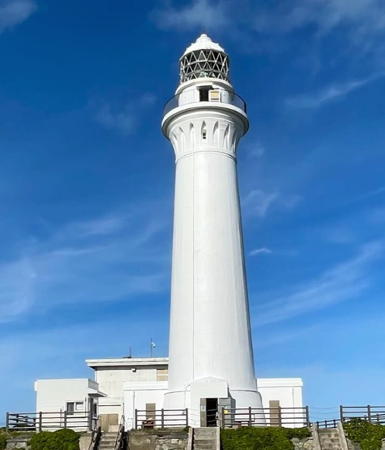

Shiriya Saki Light, Shimokita, October 2024
Instagram photo by Yutaka Okumura

General Sources
Lighthouses in Japan - Aomori
A site providing photos and data for most major Japanese lighthouses.
Lighthouse-Japan.com - Aomori
Another comprehensive site with photos and notes from visits to many lighthouses.
Form of a Lighthouse - Aomori Prefecture
This web site, cited below as FOAL, has photos for many lighthouses in Aomori.
Misty's Japanese Lighthouse Tour -Aomori
Photos and brief notes in English for lighthouses in all parts of the country.
Second Region Lighthouse Story
Posted by the Coast Guard region office in Aomori, an interactive map linking to information on the major lighthouses.
Lighthouses in Aomori Prefecture
Photos by various photographers available from Wikimedia.
Online List of Lights - Japan
Photos by various photographers posted by Alexander Trabas. Photos for Aomori are by Jim Smith.
 

Aomori Coast Guard District: Mutsu Bay Lighthouses

Mutsu Bay is a butterfly-shaped bay roughly 40 km (25 mi) long from west to east. At its northwestern corner the bay is connected to Tsugaru Strait by the 10 km (6 mi) wide Tairadate Strait. On its south side the mountainous Natsudomari Peninsula separates Mutsu Bay into its eastern and western basins. The western basin is called Aomori Bay and the eastern basin is called Noheji Bay.

Noheji Town Lighthouse
Noheji Kō
1954. Active; focal plane 12 m (39 ft); two red flashes every 6 s. 11 m (36 ft) round cylindrical tower with lantern and gallery, painted red. T. Sato posted a 2012 photo and Google has a distant street view and a satellite view. Located at the end of the west breakwater of Noheji, a port at the south end of Noheji Bay. Site and tower closed. ARLHS JPN-1078; JCG-1535; Admiralty M6641; NGA 3780.

Southern Mutsu City (Shimokita Peninsula) Lighthouses
Occupying the northeastern corner of Honshū, the Shimokita Peninsula is shaped like an ax being swung to the west. The peninsula is connected to the rest of Honshū by a narrow isthmus (the ax handle) along the east side of Mutsu Bay.

Ominato Kō
Date unknown. Active; focal plane 10 m (33 ft); red light occulting once every 4 s. 8.5 m (28 ft) concrete post attached to a square 1-story concrete equipment shelter. Entire lighthouse painted red. A 2013 photo is available and Google has a distant satellite view. Located on the east (main) breakwater protecting the entrance to Ominato, the harbor district of Mutsu City, at the extreme northeastern corner of Mutsu Bay. Site and tower closed, although the light can be seen from nearby. ARLHS JPN-1087; JCG-1538; Admiralty M6640.2; NGA 3802.

Noheji Kō Light, Noheji, May 2022
Google Maps photo by Takayuki Fujiwara
* Kuro Saki (Mutsu Kuro Saki) (2)
1986 (station established 1945). Active; focal plane 22 m (72 ft); white flash every 4 s. 12 m (39 ft) round concrete tower with flared top and gallery, but no lantern. Lighthouse painted white with one black horizontal band. FOAL's page has good photos, a 2020 closeup is available, and Google has a satellite view. The original lighthouse was a square 2-story concrete tower. Located on a promontory midway on the north side of East Mutsu Bay, about 20 km (13 mi) southwest of Mutsu. Site open, tower closed. . ARLHS JPN-1072; JCG-1541; Admiralty M6640; NGA 3804.
Wakinosawa Kō
Date unknown. Active; focal plane 12 m (39 ft); red flash every 3 s. 10 m (33 ft) concrete post attached to a square 1-story concrete equipment shelter. Entire lighthouse is red. A closeup 2023 photo and a view from the bay are available and Google has a street view across the harbor and a distant satellite view. Wakinosawa, near the southwestern tip of the Shimokita Peninsula, is the terminal for ferries crossing the mouth of Mutsu Bay to Kanita. Located on the east (main) breakwater protecting the entrance to Wakinosawa. Site status unknown. ARLHS JPN-1097; JCG-1543; Admiralty M6638.4; NGA 3809.
Mutsu Benten Shima
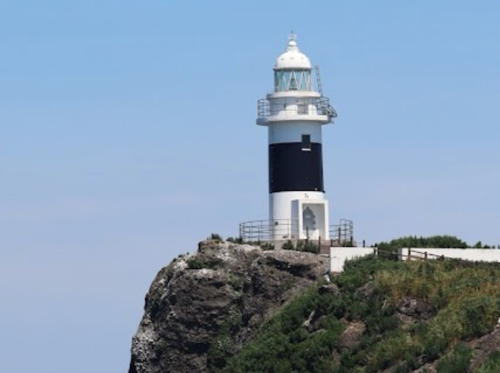
1945. Active; focal plane 36 m (118 ft); two white flashes every 7 s. 12 m (39 ft) round cylindrical concrete tower with lantern and gallery, mounted on a circular concrete base. Lighthouse painted white with a broad black horizontal band. A 2022 photo is at right, Trabas has Smith's distant view from a passing ship, a similar view is available, FOAL's page includes a closeup photo (second row on the page), and Google has a satellite view. Benten Shima is a huge rock just off the tip of the Shimokita Peninsula. As the photos show, the island looks remarkably like a giant whale. The light guides ships entering or leaving the eastern lobe of the bay. Accessible only by boat. Site and tower closed. ARLHS JPN-044; JCG-1544; Admiralty M6638; NGA 3810.

Mutsu Benten Shima Light, Mutsu, October 2022
Google Maps photo by Kiriya 111

Aomori Coast Guard District: Central Tsugaru Strait Lighthouses

Sai Town Lighthouses
Sai is a village on the rugged west coast of the Shimokita Peninsula, facing the Tsugaru Strait.

Oyo Shima (Oyojima)
Date unknown. Active; focal plane 19 m (62 ft); white flash every 3 s. 9.5 m (31 ft) round cylindrical concrete tower rising from a round 1-story concrete equipment shelter. Entire lighthouse is white. A 2023 photo is available and Google has a very distant street view from shore but the tower is not seen in Bing's fuzzy satellite view. Located on an islet about 1 km (0.6 mi) offshore and 6 km (3.5 mi) south of Sai harbor. Accessible only by boat. Site status unknown. ARLHS JPN-1088; JCG-1545; Admiralty M6637; NGA 3812.
Sai Kō
1997. Active; focal plane 13 m (43 ft); two red flashes every 6 s. 9 m (30 ft) round concrete tower with flared top and gallery, but no lantern. Lighthouse painted red. Noboru Saso has a 2022 photo and Google has a satellite view and a street view across the harbor. Located at the end of the main breakwater at Sai, a small port about 13 km (8 mi) southwest of Ōma. Site and tower closed. ARLHS JPN-1089; JCG-1547.3; Admiralty M6636.7; NGA 3816.

Ōma Town Lighthouses
Ōma occupies the northwestern tip of the Shimokita Peninsula, facing the Tsugaru Strait. Ferries cross the strait from Ōma to Hakodate, Hokkaidō.

*
Ōma Kō West Breakwater
1961. Active; focal plane 13 m (43 ft); red light, 3 s on, 3 s off. 9.5 m (31 ft) concrete post attached to a square 1-story concrete equipment shelter. Entire lighthouse is red. FOAL has a photo (2/3 the way down the page), a distant 2024 view is available, and Google has a satellite view and a distant street view across the harbor. Located on the west breakwater of the traditional harbor of Ōma (not the ferry harbor). Accessible by walking the pier. Site open, tower closed. JCG-1549; Admiralty M6636; NGA 3828.2.
Ōma Saki
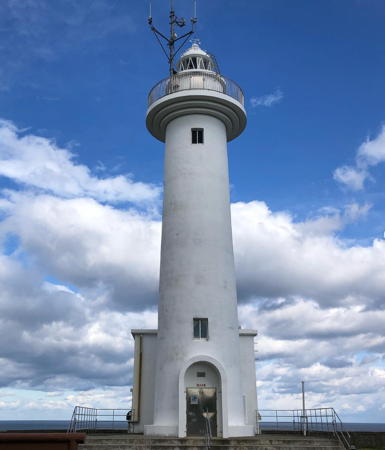
1921. Active; focal plane 36 m (118 ft); three white flashes every 30 s. 25 m (82 ft) round cylindrical concrete tower rising from one corner of a 2-story keeper's house. Tower painted with black and white horizontal bands. Fog horn (one 10 s blast every 50 s). Hiroyuki Watanabe's 2023 photo is at right, Lighthouse of Japan has a page with several photos, FOAL's page has photos, Taichiro Kogawa has a 2012 photo, Misty's Tour has a small photo, and Google has a satellite view and a distant street view from the mainland. This lighthouse marks the northernmost point of Honshū and the narrowest point of the Tsugaru Strait; from here it is 18 km (11 mi) north to Siokubi Misaki, Hokkaidō. Located on a small island off the point of the cape near the town of Ōma. Accessible only by boat. Site and tower closed. . ARLHS JPN-2636; JCG-1550; Admiralty M6634.5; NGA 3832.
Genbei Sho (Genbei Syo)
Date unknown. Active; focal plane 7 m (23 ft); two white flashes every 5 s. 7 m (23 ft) post rising from a 1-story equipment shelter. Lighthouse painted black with one red horizontal band. The light is seen in Wikimedia's photo of the Ōma Saki lighthouse, Itsuki Toyo hass a distant photo, and Google has a satellite view and a distant street view from the mainland. Located on a reef midway in the channel between the mainland and the island of the Ōma Saki lighthouse. Accessible only by boat. Site open, tower closed. JCG-1551; Admiralty M6635; NGA 3830.

Ōma Saki Light, Higashidōri, April 2023
Google Maps photo by Hiroyuki Watanabe

Hachinohe Coast Guard District: Eastern Tsugaru Strait Lighthouses

Northern Mutsu City Lighthouses
Ohata Kō East Breakwater
1979. Active; focal plane 11 m (36 ft); green light, 3 s on, 3 s off. 9 m (30 ft) concrete post attached to a square 1-story concrete equipment shelter. Entire lighthouse is white. Google has a street view and a satellite view. Located on the east breakwater of the original harbor (now the west harbor) at Ohata, about 12 km (7.5 mi) north of Mutsu. Site status unknown. ARLHS JPN-1079; JCG-1552; Admiralty M6632; NGA 3840.
Ohata Kō First East Breakwater
1979. Active; focal plane 15 m (49 ft); continuous red light with a more intense flash every 4 s. 11 m (36 ft) round concrete tower with flared top and gallery, but no lantern. Entire lighthouse is red. Google has a satellite view and a distant street view across the harbor. Located at the east end of the main breakwater at Ohata. Site status unknown. ARLHS JPN-1080; JCG-1554; Admiralty M6633.5; NGA 3836.
Sekinehama Kō West Breakwater
Date unknown. Active; focal plane 14 m (46 ft); red flash every 4 s. 9.5 m (31 ft) concrete post attached to a square 1-story concrete equipment shelter. Entire lighthouse is red. FOAL has a photo (halfway down the page, on the right) and Google has a satellite view. Located at the east end of the detached breakwater of Sekinehama. Accessible only by boat. Site and tower closed. JCG-1554.2; Admiralty M6631.5; NGA 3846.
Sekinehama Kō East Breakwater
Date unknown. Active; focal plane 14 m (46 ft); green flash every 4 s. 10 m (33 ft) concrete post attached to a square 1-story concrete equipment shelter. Entire lighthouse is white. FOAL has a photo (bottom of the page, on the right), and Google has a satellite view. Located on the east breakwater of Sekinehama. Site and tower closed. JCG-1554.4; Admiralty M6631.6; NGA 3846.5.

Hachinohe Coast Guard District: Pacific Coast Lighthouses

Higashidōri Town Lighthouses
Shiriya (Shiriyamisaki) Kō
Date unknown. Active; focal plane 14 m (46 ft); green flash every 4 s. 9.5 m (31 ft) concrete post attached to a square 1-story concrete equipment shelter. Entire lighthouse is white. FOAL has a photo, and Google has a satellite view and a very distant street view. The Shiriya harbor was built as a harbor of refuge for vessels escaping North Pacific storms. This light was relocated recently when an extension of the breakwater doubled its length. Located at the end of the east breakwater of Shiriya harbor. Site and tower closed. ARLHS JPN-1093; JCG-1555; Admiralty M6631; NGA 3848.
* Shiriya (Siriya) Saki
1876. Active; focal plane 46 m (151 ft); white flash every 10 s; also a continuous white spotlight illuminates a reef 1.4 km (0.9 mi) to the northeast. 33 m (108 ft) round brick tower with lantern and gallery, attached to a 2-story keeper's house. Entire lighthouse painted white. Yutaka Okumura's 2024 photo is at the top of this page, Daisuke Aoki has a 2021 photo, Lighthouses in Japan has a fine photo, FOAL has additional photos, a good closeup photo is available, Yari Hotaka has a 2011 photo, and Google has a street view and a satellite view. The lighthouse stands at the northeastern tip of Honshū, marking the eastern entrance to Tsugaru Strait. This tall, handsome tower, one of Japan's best known lighthouses, stands at the end of a picturesque peninsula famous for an endangered herd of feral horses. One of the few tall brick lighthouses in Japan, it was restored in 1951. Accessible by road, but parking may be limited. Located at the tip of Cape Shiriya. Site open, tower closed. . ARLHS JPN-581; JCG-1601 (general light) and 1602 (spotlight); Admiralty M6630; NGA 3852.
Shiranuka Detached Breakwater
2019. Active; focal plane 16 m (52 ft); two green flashes every 6 s. 11 m (36 ft) concrete post centered on a square 1-story equipment shelter. Entire lighthouse is white. FOAL has July 2019 photos (1/3 the way down the page) and Bing has a satellite view. This light replaced a similar light on the port's south breakwater. Located at the north end of a new detached breakwater protecting the harbor of Shiranuka, a small port about 25 km (15 mi) south of Shiriya Saki. Accessible only by boat. Site open, tower closed. JCG-1603.5; Admiralty M6628.3.
* Shiranuka (Siranuka) (2)
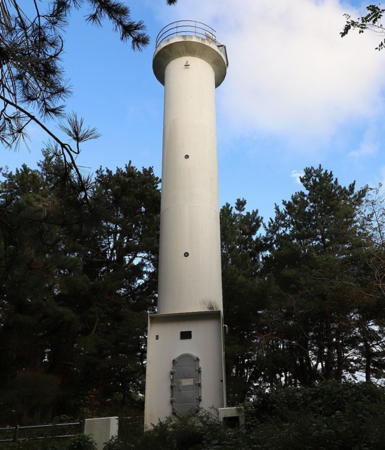
Date unknown (station established 1931). Active; focal plane 38 m (125 ft); white flash every 4 s. 14 m (46 ft) round cylindrical concrete tower with lantern and gallery. A continuous white spotlight (JCG 1604.1) that formerly illuminated the nearby South Breakwater was deactivated in 2019. Entire lighthouse painted white. A portion of Satoru Inomata's 2021 street view is at right, Lighthouse of Japan has a page with good photos, Lighthouses in Japan has a good photo, FOAL's page has photos, and Google has a satellite view . Accessible by road and a short walk, but the road to the light is not marked. Located on a bluff on the south side of Shiranuka harbor. Site open, tower closed. . ARLHS JPN-578; JCG-1604; Admiralty M6628; NGA 3860.
Mutsu Ogawara Kō
Date unknown. Active; focal plane 16 m (52 ft); continuous green light with two more intense flashes every 7 s. 13 m (43 ft) round cylindrical white concrete tower. Google has a good satellite view. Located on the south breakwater of Ogawara harbor, about 50 km (30 mi) north of Misawa. Site status unknown; this area appears to be closed. ARLHS JPN-1076; JCG-1609.4; Admiralty M6627.3; NGA 3878.

Misawa City Lighthouse
* Mutsu Shiogama (2?)
Date unknown. Active; focal plane 31 m (102 ft); white light, 3 s on, 3 s off. 15 m (49 ft) round cylindrical white concrete tower. A photo is below right, Tomio Tatsumi has a photo, a 2020 closeup is available, and Google has a satellite view. NGA lists a skeletal tower for this light. The lighthouse is in a park but the entrance is unmarked. Located in the village of Shiogama, about 30 km (19 mi) north of Hochinohe. Site open, tower closed. . JCG-1610; Admiralty M6627; NGA 3880.

Shirinuka Light, Shirinuka, July 2021
Google Maps street view by Satoru Inomata

Hachinohe City Lighthouses
Hachinohe is a city of about 225,000 residents. It is an important seaport handling containerships and oil tankers.

Hachitaro (Hachinohe) North Breakwater (2)
2013 (station establishment date unknown). Active; focal plane 18 m (59 ft); two red flashes every 9 s. 16 m (52 ft) round cylindrical concrete tower with lantern and gallery. Entire lighthouse is red. FOAL has a photo (fourth row, on the left) and Bing has a satellite view. This lighthouse was damaged by the tsunami in March 2011; it was repaired and reactivated in March 2013. Located at the end of the north breakwater of Hachinohe (Google's views show that much of this breakwater was broken and underwater even before the tsunami). Accessible only by boat. Site status unknown. ARLHS JPN-1056; JCG-1612; Admiralty M6624.8; NGA 3904.
Hachitaro (Hachinohe) Kō Detached Outer Breakwater
Date unknown. Active; focal plane 17 m (56 ft); two green flashes every 6 s. 16 m (52 ft) round cylindrical concrete tower with lantern and gallery. Entire lighthouse is white. FOAL has a photo (fourth row, on the right) and Bing has a satellite view. Located on the detached outer breakwater of Hachinohe, about 400 m (1/4 mi) from the north end. Accessible only by boat. Site status unknown. ARLHS JPN-1055; JCG-1611.8; Admiralty M6624.85; NGA 3906.
Hachitaro (Hachinohe, Hatitaro) East Breakwater
Date unknown. Active; focal plane 15 m (49 ft); two green flashes every 9 s. 10 m (33 ft) concrete post rising from a a square 1-story concrete equipment room. Entire lighthouse is white. FOAL has a photo (halfway down the page, on the left) and Google has a satellite view. Located at the end of a long pier in Hachinohe harbor. Site status unknown. ARLHS JPN-1058; JCG-1613; Admiralty M6625.5; NGA 3908.
* Hachinohe Toyosu (Aomori) Breakwater
Date unknown. Active; focal plane 13 m (43 ft); red flash every 5 s. 9.5 m (31 ft) round concrete tower, flared at the top, attached to a small concrete equipment room. Entire lighthouse is red. FOAL's page has photos (halfway down the page, on the right) and Google has a street view and a satellite view. Located at the end of a short breakwater on the east side of Toyosu wharf in Hachinohe. Accessible by walking the pier. Site open, tower closed. JCG-1618; Admiralty M6623.6; NGA 3922.
 

Mitsu Shiogama Light, Mitsawa, November 2021
Instagram photo by peugeot208de
 
Hachitaro (Hachinohe, Hatitaro) Middle Breakwater West End
Date unknown. Active; focal plane 13 m (43 ft); green flash every 5 s. 9.5 m (31 ft) concrete post rising from a square 1-story concrete equipment room. Entire lighthouse is white. FOAL has a photo (a little over halfway down the page on the left), Google has a satellite view, and the top of the light is seen in a street view. Located at the west end of the detached inner breakwater at Hachinohe. Accessible only by boat. Site status unknown. JCG-1617; Admiralty M6623.2; NGA 3928.
Hachitaro (Hachinohe, Hatitaro) Middle Breakwater East End
Date unknown. Active; focal plane 15 m (49 ft); red flash every 3 s. 10 m (33 ft) concrete post rising from a a square 1-story concrete equipment room. Entire lighthouse is red. FOAL has a photo (3/4 the way down the page, on the left), and Google has a satellite view. Located at the east end of the detached inner breakwater at Hachinohe. Accessible only by boat. Site status unknown. JCG-1621; Admiralty M6623; NGA 3924.
* Hachinohe Kabushima Jetty
1963. Active; focal plane 10 m (33 ft); continuous green light with a more intense flash every 6 s. 8.5 m (28 ft) concrete post rising from a a square 1-story concrete equipment room. Entire lighthouse is white. FOAL has photos (2nd and 3rd from last rows on the page) and Google has a street view and a satellite view. Located at the end of short jetty at the east end of Hachinohe harbor. Accessible by walking the pier. Site open, tower closed. ARLHS JPN-1065; JCG-1623; Admiralty M6624.4; NGA 3940.
Hachinohe Ō Saki
Date unknown. Active; focal plane 22 m (72 ft); continuous white spotlight illuminating the Hinode Iwa reef 430 m (1/4 mi) to the north. 8.5 m (28 ft) concrete post supporting a square spotlight enclosure and with several equipment closets at the base. Entire lighthouse is white. Gonzaburou Kitakaze has a 2021 photo and Google has a street view and a satellite view. Located on a promontory at the eastern extremity of Hachinohe harbor. Site open, tower closed. JCG-1624; Admiralty M6621; NGA 3900.
* Samekado
1938. Active; focal plane 58 m (190 ft); white flash every 8 s. 23 m (75 ft) round concrete tower with lantern and gallery, attached to a 2-story equipment building. Entire lighthouse painted white. A 2021 photo is at right, a fine closeup is available, Lighthouses in Japan has a good photo, FOAL's page has photos, Torajiro Kuruma has a 2021 photo, and Google has a street view and a good satellite view. This lighthouse is the landfall light for the port city of Hachinohe. Accessible by road; the entrance road is gated but appears to be open to walkers. Located on a promontory about 5 km (3 mi) east of Hachinohe. Site open, tower closed. . ARLHS JPN-535; JCG-1625; Admiralty M6620; NGA 3896.

Samekado Saki Light, Hachinohe, January 2021
Instagram photo by koro0621

Hashikami Town Lighthouse
* Hashikami (Hasikami, Hajikami)
1959. Active; focal plane 22 m (72 ft); white flash every 4 s. 11 m (36 ft) round cylindrical concrete tower with gallery but no lantern, mounted on a 1-story equipment room. Entire lighthouse painted white. Lighthouses of Japan has a good photo, Hiroshi Yoshida has a 2021 closeup, a 2011 photo is available, and Google has a 2011 street view and a satellite view. The lighthouse is in a small park behind an elementary school. Located on a bluff north of the port of Taneichi, very close to the prefectural border, about 15 km (9 mi) southeast of Hachinohe. Site open, tower closed. . ARLHS JPN-088; JCG-1626; Admiralty M6618; NGA 3944.

Information available on lost lighthouses:

Notable faux lighthouses:

Adjoining pages: North: Southern Hokkaidō | Southeast: Iwate | West: Western Aomori

Return to the Lighthouse Directory index | Ratings key

Posted August 15, 2006. Checked and revised October 12, 2024 Lighthouses: 28. Site copyright 2024 Russ Rowlett and the University of North Carolina at Chapel Hill.