
Wally: “Studies show that continuously checking your email lowers your functional IQ”
Next panel.
Wally: “You advised me to ‘work smarter’ so I plan to ignore all your email from now on”
Yes there is more! So funny, so true, so sad.
Accept no substitutes
Wally: “Studies show that continuously checking your email lowers your functional IQ”
Next panel.
Wally: “You advised me to ‘work smarter’ so I plan to ignore all your email from now on”
Yes there is more! So funny, so true, so sad.

Yes, the chart is correct; over 93% of the email directed at you at the University of North Carolina goes directly in the dumper. You never see it. And you should be glad.
Tim McGuire, Director of ITS Campus Infrastructure Services at UNC-Chapel Hill, has the sad job of marshaling resources and intelligence to protect you from “Evil Robots” (see my earlier article) by scanning every incoming email with “proprietary algorithms developed by the vendor to scan entire email content to determine if a particular message is a problem.” And that’s only the first step. Emulating Google, UNC uses Cisco’s SenderBase.org to try to separate Well-Meaning Robots from Evil Robots. I mean, you may have asked for that special Constant Contact sent offer for a sale at an outlet store you once stopped in for socks while driving up the interstate. But wait there is more. A total of 5 points for email “protection.”
Overall, Tim does a good job of briefly describing the efforts that an enterprise must go through to offer useable email services. That effort is complex, expensive, intrusive, highly reliant on outside resources, compute-intensive, and requires “continual reexamination of our effectiveness, constantly updated vendor algorithms, use of the latest reputation scores, and vigilance in stopping our own accounts from being compromised and endangering our reputation.” Yes, as needlessly complex as the sentence I just quoted.
There is another solution. Simpler and cheaper. Get out of the email business. And there is more to more social solutions as this new report from Forrester (on Tech Republic sponsored by IBM) on “The Business Value of Social Content” [pdf] contends.
This is a list of in-house/in-firm/in-enterprise alternatives to working with email. Most have at least chat and Trello-like features and offer collaboration features at their center. Some work well on mobile as well as laptop or desktop. I’ll be adding more notes and links, but also see your comments and additions. List is in no particular order.
Enjoyed reading Fast Company‘s “Inside the Company that got rid of email”, a report on Cristian Rennella and his company El Mejor Trado (a South American travel site) by Rebecca Greenfield. Cristian and company created their own internal communications system (ala Asana) which favors pull over push. As Cristian explains via Rebecca:
“We want to change from push methodology to pull methodology,” Rennella explained to [Rebecca]. By “push” he means the way notifications force us into doing tasks. When someone asks for “one quick thing” or “can you take a look at this?” we feel compelled to act right away. Distractions–even short ones–lead to more mistakes, research has found. It also takes a full 23 minutes to get back to the original task after an email interruption.
It seems so simple. Make technology to do the right thing for your company. The only problem is that your company grows, spreads geographically, or in sadder cases contracts. In any case, contractors and customers also need to be brought along. Nonetheless even in this test case, the savings for the company and quality of work-life improvement for the employees are indisputable.
Emma Featherstone of Guardian Smarter Working Hub asks “Have emails had their day in the modern office?” There are a number of great things about this article; not the least of which are the final paragraphs dedicated to #noemail co-conspirator Paul Lancaster and his No Email Day project.
I recommend reading Emma Featherstone’s article which covers the state of email resistance briefly and well, but I also take this opportunity to repost Paul Lancaster’s No Email Day Manifesto below.
What: 13th International Conference WWW/INTERNET
Where: Porto, Portugal
When: October 25 – 27, 2014
Who: Paul Jones – Keynote
#noemail – Why you could/should/must use better ways of communicating than email
Nearly 30 years ago Paul Jones began working on and encouraging people to use the unified messaging systems that led up to what we now know as email. That was then, and this is now. Email has become a zombie that doesn’t realize that it’s dead and falling apart, a vampire that sucks your life’s blood away slowly each night before bed and each morning as you wake. Paul Jones will explain why and how email must change. He will challenge technologists to move into the 21st Century by developing more and more appropriate communications and messaging technologies that are (at this point in time): highly collaborative, mobile preferred, whitelisted, terse, quick, highly interactive, context appropriate, available to all devices, and with highly manageable and customizable communications streams
Several articles have come out in the past few weeks that each in their own way offer complaints about too many demands put on all of us by that old folk demon, email. While each identifies at least some of the problems with email or uses email to some extent as a stand in for information overload or for American overwork (see chart from The Atlantic below), none really offers any solution other than to explain how you should control your email usage, you should not let it dominate your life, you should take time away from devices that give you access to email.
As per usual, most all offer a list of how one should behave. If you behave in these ways, all will be well they promise. There are two problems with this approach: First, no one can follow a set of seven plus productivity rules with any consistency for any long period of time. Second, even if you were to be able to do so, the habits and expectations of others and the practices baked into the technological infrastructure that is email would eventually overtake you.
I’m not a technological determinist, but the technologies must change and are changing. Yes I want more change more control and more channels. I am not in any way advocating a return to some falsely imagined email eden. Nor do I think as some do that getting rid of email will change our social tendency to look, perhaps too anxiously, for more and more information or to bind ourselves to our celebrated overwork ethic. I hope we do address those problems. And I hope that as technologists, we can continue to develop more and more appropriate communications and messaging technologies that are (at this point in time): highly collaborative, mobile preferred, whitelisted, terse, quick, highly interactive, context appropriate, available to all devices, and with highly manageable and customizable communications streams
With Labor Day approaching, two Thompsons (Derek in The Atlantic and Clive in The New York Times) explain that we are overworked. Email is the culprit as the titles of the articles tell us. First Derek’s “The Joys and Sorrows of Late-Night Email” gives its secret away in the URL “email-is-killing-us”; there are no joys to be had. We are tethered and sorrowful. We spend too much time even during our work hours “monitoring” our work. “We are doing this to ourselves,” Derek tells us. But there is little offered in the way of relief.

The other Thompson, Clive, is author of the wonderful “Smarter Than You Think: How Technology Is Changing Our Minds For The Better.” In his Labor Day weekend send off opinion piece “End the Tyranny of 24/7 Email,” this Thompson re-presents recent studies about how email interferes with our work and private lives citing the Daimler no-vacation-email strategy among others. Further he identifies, in one penultimate paragraph, the context collapse issue of email as well as the problem of expanded work and social expectations:
These changes can’t happen through personal behavior: The policy needs to come from the top. (If your boss regularly emails you a high-priority question at 11 p.m., the real message is, “At our company, we do email at midnight.”) And some changes may seem like matters of housekeeping, but have major repercussions, like keeping a separate email box for your personal messages. You can’t ignore your work inbox if that’s also the place where friends send you weepy accounts of their breakups.
For Clive, WE are not the problem as individuals, but as a socially and professionally dysfunctional society WE are the problem.
In a narrower field of play, Summer-Serenity Duvall (assistant professor of Communications at nearby Salem College) has banned student emails, purged the unfollowable rules and conscripted contexts for emailing her, as your professor, from her syllabus.
As someone who has followed this practice for over 3 years now, I applaud her and welcome her to #noemail. Each new semester, I give my students a #noemail lecture as a way to encourage them to think differently and more effectively about their communication technology usage.
But where, briefly, I differ from Dr. Duvall is that I am very happy to communicate, to interact, to carry my phone, to avoid departmentalization of my time. Pads, pods and lappys are all fine in class in many contexts — not all classes at all times of course.
The #noemail goal isn’t to regress or reject technology but to move to more appropriate technologies leaving the losers, like email, behind.
Let a thousand interactions bloom! But let none of them be email.
Two completely different takes on email and #noemail came out last week. They are bookends to the ongoing discussion about how to communicate effectively. One looking backwards and arguing for an imagined utopia; one looking forward (or at least in the present) and arguing for better interactions and better productivity.
Starting in the present, Thomas Knoll of Primeloop talks about developing a communications culture at his business rather than an email culture in his post on Medium, “I banned email at my company.”

Knoll acknowledges that email is hard to avoid for external interactions (but not impossible I quickly add), but that email culture can be replaced by learning to: Ask Questions, Share Information (using Hackpad), Passing Around Files (using Dropbox, Slack and Trello), Asking for Feedback (Hackpad), ToDo Lists (again Trello), Notifications (Slack), and Reporting to Others (WorkingOn).
All and all, a useful medium length post of a self-conducted best practices in communications amongst knowledge workers and coders with real results. Recommended.
That time when you were about 16 – 26 is that only time that music has been really really good. Probably several other things fit in that same category and time. For Alexis Madrigal, writing for The Atlantic, email is one of those things. Just like some one in his 40s explaining the music of his youth to death, Madrigal overexplains email and converts no one in his article “Email is still the best thing on the Internet.” If it’s so great why is email being abandoned and reengineered? Kids! Listen up! According to Madrigal: “Email was a newsfeed, was one’s passport and identity, was the primary means of direct social communication, was a digital package-delivery service, was the primary mode of networked work communication.” I mean WAS. But is no more. Kids-these-days with their Instagram, their WhatsAp, their Snapchat, their WhateverElseIsCool, they just don’t get it. They should rediscover email — and buy vinyl while they are at it.
Most of Madrigal’s article nostalgizes email, but even at that he does get something right. Whatever replaces email in whatever forms — including I agree Instagram, SnapChat etc — would be better for the customers and better for their companies in the long run if there were open standards for such services. Yes, I plan to make that case in October at the 13th annual WWW/Internet Conference in Porto, Portugal.
This past two weeks brought to my attention four challengers to email overload and a promise of more #noemail alternatives. The three applications, like many emerging alternatives, attempt to include mobile friendliness, terse messaging (sometimes with stickers or visuals), highly interactive communication and context appropriateness.
Charleston SC’s Post-Courier interviews Twitpics founder, Noah Everett, as he challenges email with Pingly. Okay not so much challenges as offers a delay of sorts. Pingly is said to come “from the phrase ‘Ping me’ (send me an email later.)” And in a display of tortured syntax: “We’re building basically from the ground up a brand new email service.” If someone is on your Pingly whitelist, their messages get marked as important. Despite the hype, Pingly is really an interactive whitelist management system for your inbox. Not #noemail.
Meanwhile, TechCrunch’s MG Siegler aka @parislemon, who himself did a brief #noemail stint, looks at signals from Twitter about extending their DM feature as an email killer. Siegler promises or predicts only a maiming of email in his title, but he opines and predicts and wishes from much more. I do too. DMs are one of my favorite features of Twitter, a back channel to the public Tweet Stream (as Siegler also notes and loves). An additional shared passion we share is for the forced terseness of Twitter communications: “But wait, Twitter DMs are only 140 characters, that will never work! In the context of email, that would very much be a feature not a bug.” But remember this article isn’t about what is now available so much as a wish list for Twitter developers.
I haven’t yet tested, Slack, which The Verge hypes as an email killer in an interview with founder Stewart Butterfield. Butterfield, himself has been #noemail for over 4 years (he says), so we can expect some insight here as well as a working product. Slack was developed, not coincidentally, about 4 years ago as a chat tool for Massive Multiuser Online games (MMO) — where terseness, interactivity, whitelists, and context control are essential. So far so good. Even better, Slack integrates communications across applications. As Butterfield says “It’s all your communication in one place, instantly searchable, and available wherever you go” or in market-speak “It’s a messaging and search platform that creates a single unified archive accessible through powerful search.” Despite the promise of #noemail, Butterfield hedges his bets by offering to integrate email into Slack in the future. In doing so, he repositions Slack from an email killer or an alternative communications integration play. The sort of Swiss Army Knife with too many specialized blades to fit into your pocket.
Vergers talk about Slack mostly loving the search but also talking about teams using Slack. And rightly dissing email.
Washington Post writer, Brigid Schulte, gets to Mailbox Zero and tells you how. Like getting into Carnegie Hall: practice, practice, practice. Well, a little more that that. Schulte proposes a set of practices that will, if followed with discipline, at least reduce your inbox size if not enhance your life. If you are anxious enough to be disciplined. What we know about people, just look at your desk clutter for a second, is that more than a few of us have that kind of self-discipline. And we look askant at those who do, seeing them as OCD or just anal. Not that Schulte’s practices are bad ones. They are very good. But they are also just simple common sense productivity practices whether in regards to email or to any other business task that can overwhelm you.
Why not just go nuclear on the Inbox at the corporate level as the German giant Daimler has done with their employees by promising to have all incoming emails received while on vacation deleted so not return to bulging inbox as reported in Financial Times (registration required)? [precis of the article here at The Atlantic without blockage].
This past two days, I’ve been a bit split–talking about keeping yourself and your sources secret on one day then on how you should share knowledge (without email) the next night.
On Friday, I spoke about Tor and how it can be used (correctly) by journalists at the Reese News Lab.
And on Saturday, I gave the Robert Ballard Lecture for the Carolinas Chapter of the American Association for Information Science and Technology on #noemail. The #noemail talk is a completely updated version focusing on why email will be replaced (largely) by social and sharing, how this is already happening and what factors are driving that change.
On January 30, Luis “elsua” Suarez visited our UNC School of Information and Library Science senior capstone course on Emerging Issues and Technologies to talk with us about his 6+ years without email while at IBM.
Luis brought a lot of good insight to the class as he did a Google Hangout with us from his home on Gran Canaria. Luis lives in Africa, reports in Europe and works most closely with a team in North America — without using email.
Near the end of his talk, he told us a little — very little — about his new adventure which was to start only a few days later. Luis is a charter member of Change Agents Worldwide.
Luis, who was extremely generous to spend time with us during his transition, will be moving from being a Change Agent within a very large global and hierarchical organization to advising and assisting organizations of all sizes to work better by learning about Social Business practices.
Luis has been a global presence already as has been noted in Wired, New York Times, and at Outside The Inbox dot EU (among others). His experience and personal engagement will definitely be a leader and advisor to call on.
Working with Luis has taught me not to look for the smartest person in the room but to look for the smartest network that has someone in the room with you.
Looking forward to his and CAWW’s future adventures.
Tis the season for email scams and hacks and trojans. As the holidays go into full swing, you suddenly find that “You Are A Winner!” or “Reset your password here” or the most evil of all “Someone changed your password — login to confirm or reset.”
This last works not just with email but with Facebook and other services as well. It may arrive via txt, FB message but usually via email. Bill Hayes writes somewhat forgivingly of his experience with the human engineered phishing of his friends by his compromised Gmail account in today’s New York Times, “Thank You for Hacking Me”
Not to take the fun out of the story, but one upside is that Hayes lost 9,187 items from his Gmail inbox. Clearly he needs better email management — and #noemail.
Last month a friend of mine had her Facebook account cloned. The new account immediately began friending all of the real person’s friends. As soon as you were friended, the phishing began.
I returned the friend request to see what was up. Soon I got a “Hello Message” then I decided to have fun:
[fake friend] Hello
[me] hello [friend’s name]. Maybe you can help me
I think I left a wallet at your house [I have never been to her house][ff] I will check it out and get back to you
[me] maybe under the coffee table
[ff] Ok
[me] near the red chair
It has some very important papers in it
on the subject we were talking about[ff] Ok
[me] I can’t say much about that here obviously
But there is a lot at stake[ff] Ok
[me] be very casual while you are looking
[ff] ok
[me] this is very important. you know the chair i’m talking about?
[Chat Conversation End]
Of course I reported the false account just after. And it was soon gone.
Business Practices That Refuse To Die (but should) via Kevin D. Jones of Decog Yourself
Thanks to Sebastian Schäfer
From Germany, Harald Schirmer explains how email causes pain which blogging can abate. Click on the image for his full contribution and full explanation. Very well done. 
Reconnections with two old friends with #noemail connections this morning.
First Paul Gilster writes about not being able to go #noemail in the News & Observer. He has nice things to say (and mentions me and the #noemail life I’m leading), but as I comment:
Paul,
Why be negative?
it’s not quitting email, it’s communicating in better ways. #noemail is saying “I’m here but I don’t live at my desk” “I’m social when more appropriate” “Say it quickly and be direct” “Less covering your rear at work by CCing your boss at every move; work it out your self” “More sharing” and in the end a richer life.
As for email, it was adequate for the needs of the late 20th Century.
We don’t live there any more.
Peace out,
Paul
Paul is doing great work about space travel at Centauri Dreams. Perhaps he’s seen ibiblio – the movie.
Second, my ole pal and running buddy, Tom Wilkinson, who does no email and no social media is featured in Charlotte Magazine telling his tall — but also true — tales in “The Entertainer: the Backstage Live of Tom Wilkinson.” No page can contain Tom’s talking and animated presentation, but this is a good tribute and a good primer. Email could not do him justice, but maybe YouTube or Vimeo could.

I had a great time this Monday at the RTP Foundation taking part in 5 minute talks on open source projects called “RTP 180: Open Source All Things.” While I talked — slightly over my 5 minutes, I’ll admit — just over 60 slides representing about 1% of the projects currently hosted at ibiblio.org passed by on the screen at about 3 seconds each. That could have been a little fast for some people, so I’ve reposted those slides here:
On Wednesday, I took the #noemail message to the Duke Libraries as “Imagine Life without Email” where one former ibiblian and current Duke Libraires developer taunted me by sending an email in my presence with not one but two attachments. Will is, of course, the source of his own pain as Oscar Wilde observed “We are each our own devil, and we make this world our hell.”
Slides from that talk are here (note that Is Good doesn’t trust Google Docs but I assure you this link is fine):
MIT’s Daniel Smilkov, Deepak Jagdish, and César Hidalgo have created a great Gmail metadata visualization tool called Immersion. The first thing that Immersion does is map your email interaction networks in a nice interactive way. You can see networks emerge, strength of ties (via number of interactions), isolated mail bombers (usually listservs or alerts), and relationships easily and beautifully.
For me this is particularly nice as you can control the time periods that are mapped. So I mapped my email interactions for the three years before I quit email, then the two years after having stopped doing email, finally the past month of #noemail (this past month).
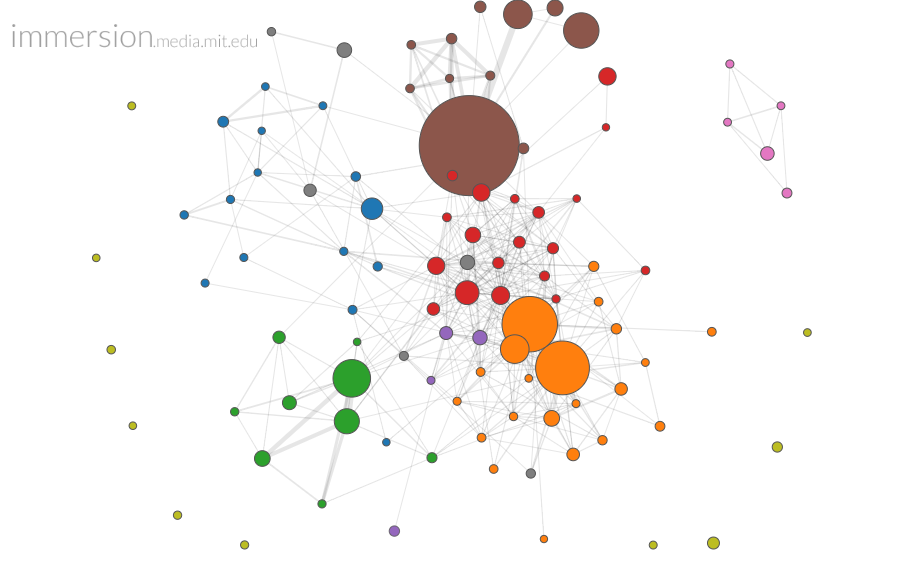
Mail networks pre-#noemail (3 years)

Mail networks since practicing #noemail (2 years)
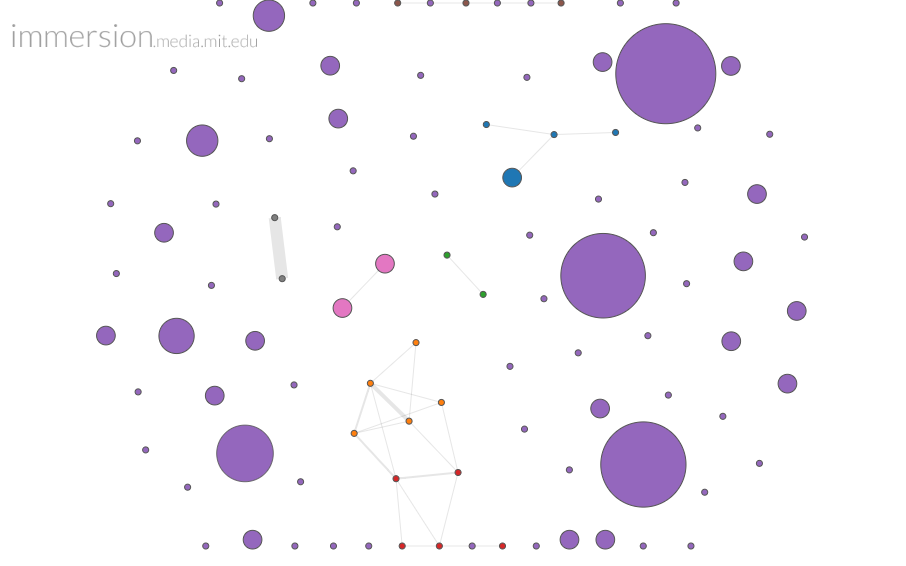
Mail Networks in the past month #noemail (June 2013)
I”m delighted that the slide deck from our webinar made it into a blog post by Luis Suarez called Meet Your New CEO; Your Kid.
Luis recounts some of his motivations for beginning to Live A Life Without Email over five years ago. The speculates about our futures at work, at home and in the world. Looking at our kids is a good way to learn the ways of an evolving world — even if one lesson is to start forgetting what you’ve always found useful and helpful.
Luis includes this video of kids evaluating their current social media (SnapChat, Tumblr, and Whisper.sh are not mentioned)
Be sure to read his post.
Yesterday, Luis Suarez (IBM Europe), Robert Shaw (Blue Kiwi & ATOS) and I did a webinar for the Information Overload Research Group on “How can business survive without e-mail at all?”
The webinar is captured here by Charlie Davidson of Attensa (and IORG). Nice moderation was provided by Marty Bariff of Illinois Institute of Technology.
The slides I created for my part of the talk are here:

© 2025 The Real Paul Jones
Theme by Anders Noren — Up ↑
Recent Comments